The barn raising I still think about started with a black square of ash in a field. I'm not Amish, but I was there, and by full light there were maybe a couple hundred people in that field. Nobody stood around asking what to do. By mid-afternoon there was a barn, roof on, where that morning there'd been nothing.
People who hear a story like that tend to ask two practical questions. Do the Amish pay taxes? And if they don't carry insurance, who pays when someone ends up in the hospital? The answers are more interesting than the myths, and they say a lot about what real security looks like.
Yes, they pay taxes
The Young Center for Anabaptist and Pietist Studies at Elizabethtown College, one of the main research centers on Amish life, answers this in its frequently asked questions. The Amish pay income, property, sales, estate, corporate, and school taxes like everyone else. Many pay school taxes twice, in effect, because they fund the public schools and also run their own.
The exception is Social Security. Congress exempted the Amish in 1965, and the Young Center explains why: they viewed it as a form of commercial insurance, which they opposed. Most Amish don't pay into it, and they don't collect from it.
The terms of that exemption tell you the most. The Social Security Administration's answer on religious exemptions says the person has to waive all benefits, including hospital insurance. They also have to belong to a religious group that makes reasonable provision of food, shelter, and medical care for its dependent members, and has done so continuously since 1950. In other words, the exemption rests on the community taking care of its own. It has limits, too. Amish America's guide to Amish taxes notes that Social Security tax can still apply to young people not yet baptized, to businesses with mixed Amish and non-Amish ownership, and to Amish employers who hire non-Amish workers.
Why most don't carry insurance
Most Amish don't buy commercial insurance. A study of Amish healthcare financing published in the journal Healthcare, Sharing the Load, describes the reasoning: many Amish believe commercial plans undermine the duty of accountability within the community.
The way I'd put it: if a company pays, your neighbors don't have to show up, and showing up is the point.
That doesn't mean refusing medical care. The Young Center notes that many Amish use modern medicine and the services of doctors and hospitals, and that practice varies a great deal from family to family and group to group. Hospitals cost money for them like anyone else. The question is who carries the bill.
How the money moves
It starts with the church district, the basic unit of Amish life. It's deliberately small, roughly twenty to forty families, about the number that can gather in one home for worship. A group that size knows who's struggling without anyone keeping a ledger.
The deacon and the alms fund. Each district usually has a deacon, and in many settlements the deacon quietly looks after members in need and the fund kept for them. When a bill lands that one family can't carry, the deacon knows the family and knows the bill, and the district gathers what's needed. For a big enough bill, neighboring districts can be asked to help.
Benefit auctions. Goods, furniture, livestock, and above all quilts get donated and auctioned, and the money goes toward a family's medical bills or a fire loss. Lancaster County's spring "mud sales" are a different kind of benefit auction. They're major fundraisers for the local volunteer fire companies, the crews that answer calls at Amish and non-Amish farms alike.
Organized aid plans. Some communities have built standing arrangements that spread large medical bills across many households. The Healthcare study describes one of them, Amish Hospital Aid, run by unpaid administrators who also work with hospitals on discounts. Not every group takes part. More traditional communities are less likely to join, and some see a formal plan as too institutional. There's no single Amish system.
Labor. This is the part that never shows up as money at all. A barn raising is labor. So is plowing a laid-up neighbor's field, or two weeks of meals after a birth or a death. A great deal of what would land as a bill in your life or mine gets absorbed as work, by people who expect the same help someday. A large share of the cost never becomes a cost.
It's reciprocity, not charity
Here's the hinge. Charity runs one way, from a giver to a receiver. Mutual aid has members, and every member is both. The family whose barn burned this year raised other people's barns for years before, and will raise more after. In that community's eyes, they're paid up.
That's also why it works without a company in the middle. Every person swinging a hammer knows that if their own barn burns next spring, this same crowd will be in their lane.
The honest cost
I won't sell you the romantic version. The web holds because people conform. The Ordnung, each community's set of rules, varies from district to district, but it's binding wherever you are, and it shapes how people dress and work and which technology they use. Inside a web that dense, your business is, to a real degree, everybody's business. Amish communities have made a coherent trade: a large measure of privacy and individual choice in exchange for a depth of security most of us can barely picture. From the inside, you don't get to pick the parts you like.
And none of this is an argument for dropping your own insurance. Their system works because of a church and generations of shared practice. You can't copy the deacon's fund. It belongs to a church you're not a member of.
The part that transfers
What you can take is the beam underneath it: local, face-to-face relationships with people who've agreed to back each other up. Nothing about that belongs to one faith. It's how most people lived until recently.
Start small, because it is small at the start. Learn the names of the neighbors on either side of you. Be the one who shows up first, with a saw after the storm or a meal when the new baby comes, and don't keep score. Say out loud that your ladder is there to borrow, and ask what they've got. Trade work when you can. Over time, a few households who've helped each other can make it explicit: if you're stuck, call me, and if I'm laid up, I'm calling you. It's looser than a church district, and weaker at first. It's still the same beam, and it can carry you through things a stockpile can't.
If you're curious about the other half of how they live, Do the Amish Use Electricity? covers how they choose technology on purpose. And the full mutual-aid chapter, with concrete first steps for building your own version, is in The Amish Survival Guide.
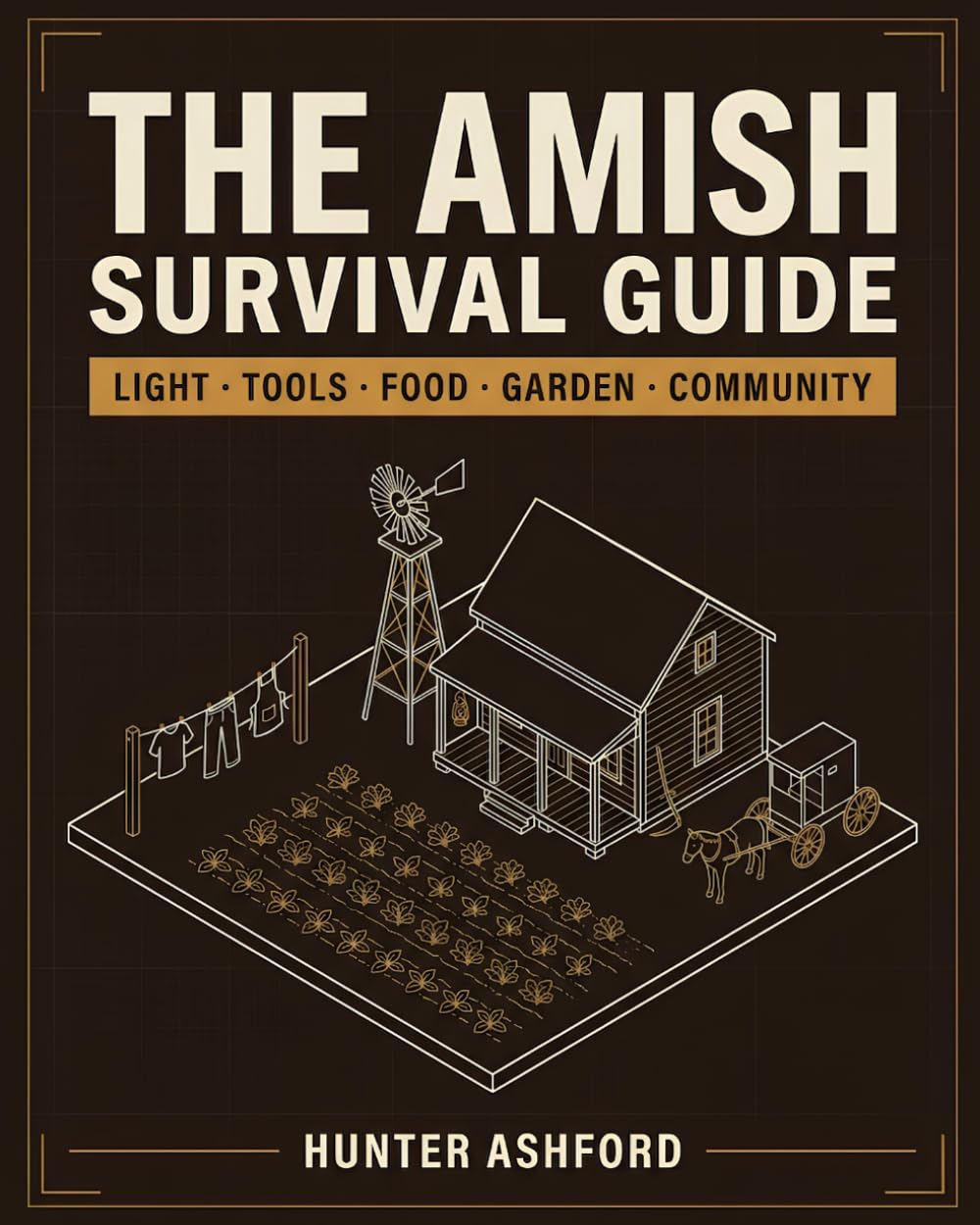
An honest, illustrated guide to the Amish practices that still work, from light and heat without the grid to the community model behind it all.
About the book