The short answer is yes, and the longer answer is more useful. Amish households don't reject electricity across the board. What most of them keep out of the house is one particular thing: the utility line that runs from the pole on the road. In many settlements, batteries, propane, diesel engines, compressed air and, in some communities, solar panels are part of ordinary life. Each one was let in on purpose.
I'm not Amish, and I've never lived under an Ordnung. What follows comes from years of living within a short drive of Plain communities and asking questions. I check what I've learned against the people who study these communities for a living, mainly the Young Center for Anabaptist and Pietist Studies at Elizabethtown College.
The rule is about the wire, not the current
The Young Center puts it plainly in its page on Amish technology: most Amish groups forbid electricity from public utility lines, and they don't consider technology evil in itself. The objection is to what the wire ties a household to. Amish America gives the reasons. Public power would bring a household too close to the world and open the door to television, radio, and the internet. And labor-saving devices would take away the shared work that builds character in children. Keeping the line out keeps the home pointed at the family and the work in front of them.
The timing tells you something too. The same source notes that the Amish in Lancaster County, Pennsylvania, had banned public power by 1920. That was a decision made early, while public power was still new to rural Pennsylvania.
What runs the house instead
There's no single system. It's a toolkit, built up piece by piece over generations, and every piece has its own job.
Propane and natural gas do the daily work in a lot of homes: lighting, ranges, and gas refrigerators that make cold from a small flame instead of a motor. Amish America notes that gas-powered refrigerators are the most common way Amish households keep food cold. If you're thinking of copying any of this at home, read the safety notes further down first.
Batteries carry the small loads. The Young Center describes battery power as more local, controllable, and independent from the outside world. In some settlements it runs lights, fans, calculators, and cash registers.
Diesel engines recharge batteries and run specific equipment, like a washing machine or a shop's air compressor.
Compressed air and hydraulics run a lot of Amish shops. One engine drives a compressor, and the tools run on air piped through the building. This is the setup often called "Amish electricity."
Solar, in some communities though not all, charges batteries and runs electric fences.
Not every district draws the line in the same place
There's no headquarters and no single rulebook. Each church district keeps its own Ordnung, which the Young Center describes as district-specific regulations, usually unwritten, passed on by practice and oral tradition. The Young Center's FAQ notes that this leaves wide variation in what's permitted. Some of the most conservative groups, like the Swartzentruber Amish, don't permit the engine-driven air and hydraulic systems described above, according to Amish America.
Telephones show the logic well. Amish America's page on Amish phone use explains that churches banned phones in the home but never banned using one. Many families share a phone shanty at the end of a lane, and workplaces often allow more than homes do. The phone isn't refused. It's put where it serves without running the household. So when someone asks whether "the Amish" allow something, the honest answer is usually that some districts do and some don't.
Why solar is the tell
Solar panels on barn and shop roofs can look like a break with all of this. For the districts that allow them, they fit the old reasoning. Power that comes off your own roof is local, controllable, and independent from the outside world, the same qualities the Young Center names for batteries. Weighing a technology their grandparents never saw, district by district, is what a living set of rules does.
The question worth borrowing
The Young Center sums up the approach as seeking to master technology rather than become its slave, and its FAQ describes choosing the technology that serves the community rather than weakening it. The question is less whether a tool works than what it will do to the people using it.
You can borrow that habit without owning a buggy. Before the next device comes into your home, run it past three tests. Does it make you more capable, or does it quietly do the job for you until you can't? Does it pull your household together, or scatter everyone into separate rooms? And if you couldn't set it down for a month without a fight, it's worth a second look.
If an outage is what brought you here
The practical side runs in an order. Light comes first, because it's the first thing you lose. Then a safe way to cook, then cold storage if the freezer is your recurring worry, and stored power last, once you've lived through an outage or two and know what you'd power.
A few lines don't move. The CDC's power outage guidance recommends battery-powered flashlights and lanterns over candles and gas lanterns, and that's where I'd start too. Anything that burns fuel inside has to be made and vented for indoor use, and backed by battery-powered or battery-backup carbon monoxide alarms. Never use a camping stove, a camping lantern, or a grill inside the house. A generator runs outside, never in the house, basement, or garage, and well away from any door, window, or vent, as the CDC spells out. And anything that connects to your home's wiring is a job for a licensed electrician, with whatever permit your state, county, or city requires.
If you want the outage side laid out step by step, I wrote Where to Start: Backup Systems for Your House.
Where the full picture lives
The Amish Survival Guide starts here, with the five misconceptions people bring to the Amish and the reasoning underneath the choices. From there it covers light, heat, cooking, and cold storage without the grid. It includes a starter battery-and-solar system that runs standalone, with any tie-in to the house left to a licensed electrician, and the community model that holds all of it together. Each skill comes with a diagram or checklist, an honest call on whether it's worth your trouble, and one place to start.
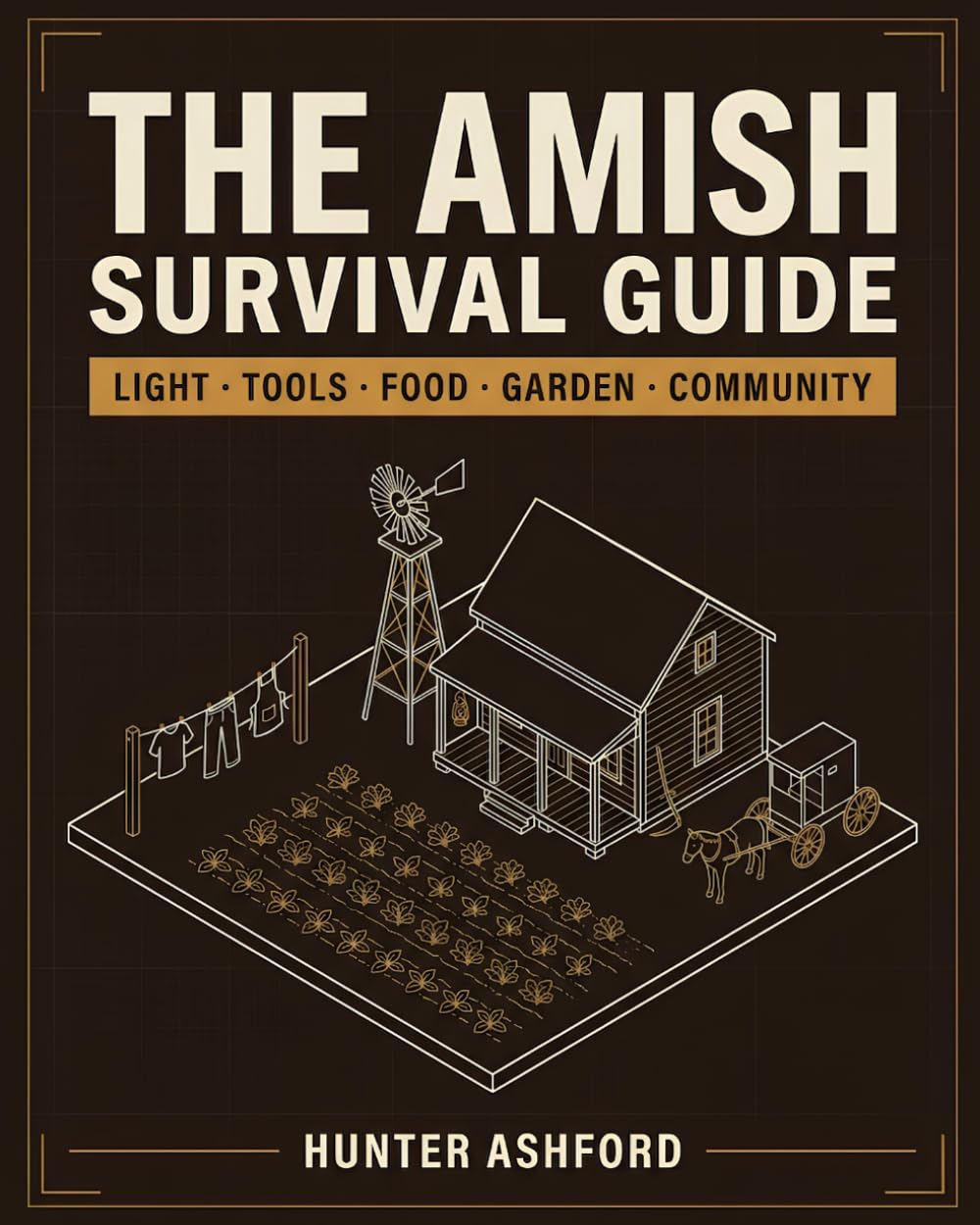
An honest, illustrated guide to the Amish practices that still work, from light and heat without the grid to the community model behind it all.
About the book